Showing posts with label Travel. Show all posts

Friday, May 13, 2016

Trip to Florence

Florence is one of the most beautiful cities in the world. It is the most populous city in Tuscany.. It has been called the "Athens of the Middle Ages". The Historic Centre of Florence attracts millions of tourists each year. The city also contains numerous of museums and art galleries.

Florence is known as the "cradle of the Renaissance" for its monuments, churches, and buildings. The best-known site of Florence is the domed cathedral of the city, Santa Maria del Fiore, known as The Duomo, whose dome was built by Filippo Brunelleschi.  It is considered as the largest dome built in brick and mortar in the world.

Here are some of the pictures I took for The Duomo on my Trip to Florence..


Above the main door is the colossal clock by Paolo Uccello (1443). This one-handed liturgical clock shows the 24 hours of the hora italica (Italian time), a period of time ending with sunset at 24 hours. This timetable was used until the 18th century. This is one of the few clocks from that time that still exist and are in working order.


The layout and structure of Florence in many ways harkens back to the Roman era. Nevertheless, the majority of the city was built during the Renaissance.

Another building that dominates Florence's skyline beside the  Duomo is The Palazzo Vecchio which is the town hall of Florence and also an art museum.  Here is the shot I took for the Palazzo Vecchio..


The River Arno cuts through the old part of the city..


Aside from its monuments, Florence contains beautiful numerous major squares and streets like ..


The Ponte Vecchio  is a Medieval stone closed-spandrel segmental arch bridge over the Arno River, in Florence noted for still having shops built along it, as was once common. Along the Ponte Vecchio, there can be seen many padlocks affixed in various places, especially to the railing around the statue of Benvenuto Cellini,an Italian goldsmith, sculptor, draftsman, soldier, musician, and artist who also wrote a famous autobiography and poetry .

Here is a shot for the statue of Benvenuto Cellini..


Hope you enjoyed my trip  ;)

Thursday, May 12, 2016

My Spring 2016 Flowers Collection


As Christian Dior said: “After women, flowers are the most lovely thing God has given the world”.  Spring is here and flowers are blossoming everywhere... So I took some time to enjoy looking to their beauty.. and here are some of the pictures I took along the way.. I hope you enjoy my collection ;)


“Flowers always make people better, happier, and more helpful; they are sunshine, food and medicine for the soul”. – Luther Burbank


“There are always flowers for those who want to see them.” – Henri Matisse


“You’re only here for a short visit. Don’t hurry, don’t worry. And be sure to smell the flowers along the way” – Walter Hagen


“Flowers are restful to look at. They have neither emotions nor conflicts.” – Sigmund Freud


“Earth laughs in flowers” – Ralph Waldo Emerson

Monday, April 18, 2016

Aurora


What is Aurora?

An aurora sometimes called “polar light” is a natural light display in the sky, seen in the high latitude in the two poles: Arctic and Antarctic. The aurora is actually collisions between electrically charged particles from the sun that enter the earth's atmosphere. The lights are seen above the magnetic poles of the northern and southern hemispheres. They are known as 'Aurora borealis' (meaning -'dawn of the north') in the north after the Roman goddess of dawn, Aurora, and the Greek name for the north wind, Boreas, by Galileo in 1619 and 'Aurora australis'  (meaning - 'dawn of the south') in the south has features that are almost identical to the aurora borealis and changes simultaneously with changes in the northern auroral zone. It is visible from high southern latitudes in Antarctica, Chile, Argentina, New Zealand, and Australia.


But why auroras are most likely to be found at the poles of the planet?

The North and a South Pole of the earth are Just like a bar magnet. The magnetism at the poles reaches all of the way down into our planet’s core and the particles follow an invisible magnetic line down the poles. Since the magnetic and geographic poles aren't the same, sometimes the auroras are visible farther south than one might expect, while in other places it's farther north. The Earth’s atmosphere is made of two main gases called oxygen and nitrogen. Both of these gases are made of the molecules and when they collide with the particles thrown out by the Sun, they emit the colors that turn the darkest of skies into a beautiful light show.

The lights appear in many forms from patches of light to streamers, arcs, shooting rays that light up the sky with an eerie glow. Aurora appears in many colors like pale green and pink and also sometimes shades of red, yellow, green, blue, and violet. Variations in color are due to the type of gas particles that are colliding. The lights of the Aurora generally extend from 80 kilometers to as high as 640 kilometers above the earth's surface.


What causes the Aurora?

A full understanding of the physical processes which lead to different types of auroras is still incomplete, but the basic cause involves the interaction of the solar wind (The solar wind is a stream of charged particles released from the upper atmosphere of the Sun) with the Earth’s magnetosphere. In other words, the temperature above the surface of the sun is millions of degrees Celsius. At this temperature, collisions between gas molecules are frequent and explosive. Free electrons and protons are thrown from the sun's atmosphere by the rotation of the sun and escape through holes in the magnetic field. Blown towards the earth by the solar wind, the charged particles are largely deflected by the earth's magnetic field. However, the earth's magnetic field is weaker at either pole and therefore some particles enter the earth's atmosphere and collide with gas particles. These collisions emit light that we perceive as the aurora.


Legends of the Lights


Many cultural groups have legends about the aurora. In medieval Europe, the auroras were commonly believed to be a sign from God.The Maori of New Zealand shared a belief with many northern people of Europe and North America that the lights were reflections from torches or campfires. The Menominee Indians of Wisconsin believed that the lights indicated the location of giants who were the spirits of great hunters and fishermen. The Inuit of Alaska believed that the lights were the spirits of the animals they hunted: the seals, salmon, deer and beluga whales. Other aboriginal peoples believed that the lights were the spirits of their people.


Sunday, April 10, 2016

Polar Bear


I have been teaching my toddler about animals lately. So I thought why not share these precious information on my blog to know more about our planet earth and teach our children to appreciate it and save it.


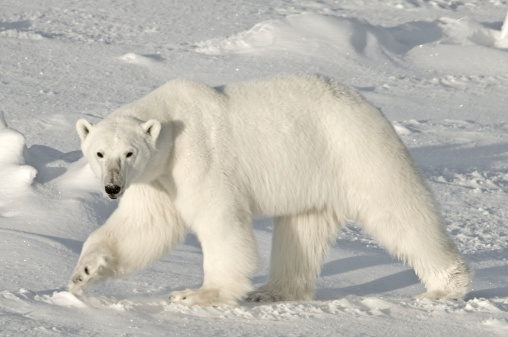
It started by the polar bear (also known as Ursus maritimus. Sea Bear. Ice Bear. White bear).  Ursus maritimus is the scientific name. It means 'maritime bear' in Latin language due to the animal's native habitat. I have liked this animal since I was a child. But what I have learned is so much more than this pretty look. And the first interesting information that I have learned is, although children's books often show polar bears and penguins together, the two live at opposite poles. Polar bears live in the Arctic (North), a massive frozen sea surrounded by continents. Penguins live in Antarctica (South), an ice-covered continent surrounded by oceans.


Polar bears are well-adapted to a life on the sea ice and Arctic weather that can be fiercely cold. In the High Arctic, the sun sets in October and doesn't rise again until late February. Winter temperatures can plunge to -40° or -50° F and stay that way for days or weeks. Their two layers of fur and a thick layer of body fat provide polar bears with such excellent insulation that their body temperature and metabolic rate won't change even when temperatures reach -34º F. Compact ears and a small tail also help prevent heat loss. A polar bear's body temperature is 98.6º F—average for mammals. However, Polar bears have more problems with overheating than they do with cold. That's why they typically walk at a leisurely pace. They can quickly overheat when they run.


To build her den, the female excavates a small snow cave—just large enough for her to turn around. She then waits for the snow to close the entrance tunnel. In most of the Arctic, pregnant females dig maternity dens in fall and give birth to cubs in early winter. She gives birth to one, two, or three cubs in November or December. Twins are most common. Until March or April when the cubs are strong enough to survive outside and ready to make the trek to the sea ice to emerge from the den, mother and cubs spend much of their time sleeping. During this time, they live off their fat reserves.


The polar bear's main prey is the ringed seal. Polar bears usually hunt ringed seals by waiting for them to breathe at openings in the ice or at breathing holes. Polar bears will also stalk seals that are hauled out on top of the ice. Polar bears locate breathing holes with their powerful sense of smell and lie in wait for the seals to rise. Polar bears have to be smart and patient because the wait can be long—from hours to days.

Polar bears' lives are a cycle of feasting and fasting. When hunting is good and a polar bear is in good body condition, the bear will eat only the seal's blubber and skin. Scientists have found that when polar bears dine exclusively on seal fat, their cholesterol levels drop lower than those of fasting bears likely due to the protective quality of the omega-3 fatty acids found in the seals.


Polar bears like to be clean and dry because matted, dirty, and wet fur is a poor insulator. In summer, if the bears find something to eat, they feed for 20–30 minutes and then head for open water and spend up to 15 minutes washing off. They also lick their paws, chests, and muzzles. They dry themselves by shaking off excess water and by rubbing their fur in the snow. In winter, polar bears clean themselves with snow. They rub their heads in the snow, push forward on their tummies, and roll on their backs. Mother polar bears lick their cubs to keep them clean. Cubs also lick themselves and each other. After cubs leave the den, they learn how to wash in snow and water.


 Most polar bears sleep for seven to eight hours at a stretch and they take naps, too. In that way, they're a lot like people. On the ice in spring and summer, polar bears tend to sleep more during the day than at night, probably because seals are more active at night. But day and night hold little meaning in the Arctic where there are 24 hours of daylight in summer and 24 hours of darkness in winter. Polar bears nap just about anywhere and anytime, and especially after feeding on a seal. Napping helps bears conserve energy. A polar bear's entire existence centers on hunting and conserving energy. In winter, polar bears sleep in shallow pits they dig in the snow with their sides or backs to the wind.


Today, the primary conservation concern for polar bears is habitat loss and reduced access to their primary prey due to climate change, not harvest. Other challenges include increased commercial activities, pollution, disease, inadequate habitat protection and the potential for overharvest in smaller or declining sub-populations.
It's been known that polar bears do kill - and sometimes eat - their own kind for some time. But the behaviour appears to be on the increase.
Ross's research is published in a paper in the journal Arctic, 'During breakup and melting in summer, the area of sea ice around the Svalbard Archipelago declines to a fraction of the winter total, and in many areas it disappears completely.'
'As the area of sea ice that polar bears can use for hunting declines, progressively fewer seals are accessible to the bears, and therefore the bears' hunting success likely declines as well.'
'Thus, at this time of year, young polar bears may represent a possible food source for adult males. As the climate continues to warm in the Arctic and the sea ice melts earlier in the summer, the frequency of such intraspecific predation may increase.'

Check this video: https://www.youtube.com/watch?v=Rfo233Q6aOg&sns=fb

References